Cancer diagnostic pathways
Rapid, consultant-led urological cancer diagnostics
Clear, structured pathways for the investigation of blood in the urine and suspected prostate, bladder, kidney and testicular cancer - from your first symptoms to an accurate diagnosis.
Why pathways matter
A clear route from symptom to diagnosis
Urological cancers are highly treatable when identified early. Mr Babu provides a focused diagnostic pathway for blood in the urine, prostate, bladder, kidney and testicular cancer - using modern imaging, laboratory testing and, where needed, targeted biopsy to reach an accurate diagnosis quickly, and to reassure patients.
The common first sign
Blood in the urine (haematuria)
Visible or microscopic blood in the urine is one of the most important early signs of urological cancer and should always be investigated. It can arise from the bladder, kidneys or prostate. Up to a quarter of patients presenting with visible blood in the urine may have an underlying cancer diagnosis, though many cases have a benign cause such as infection or stones.
We offer prompt haematuria assessment, typically combining urine testing, imaging of the kidneys and a flexible cystoscopy to examine the bladder lining directly.
Typical haematuria assessment
- Consultation & urine testing to review symptoms and risk factors.
- Imaging of the kidneys and upper urinary tract.
- Flexible cystoscopy to inspect the bladder lining under local anaesthetic.
Prostate cancer
Prostate cancer diagnostics
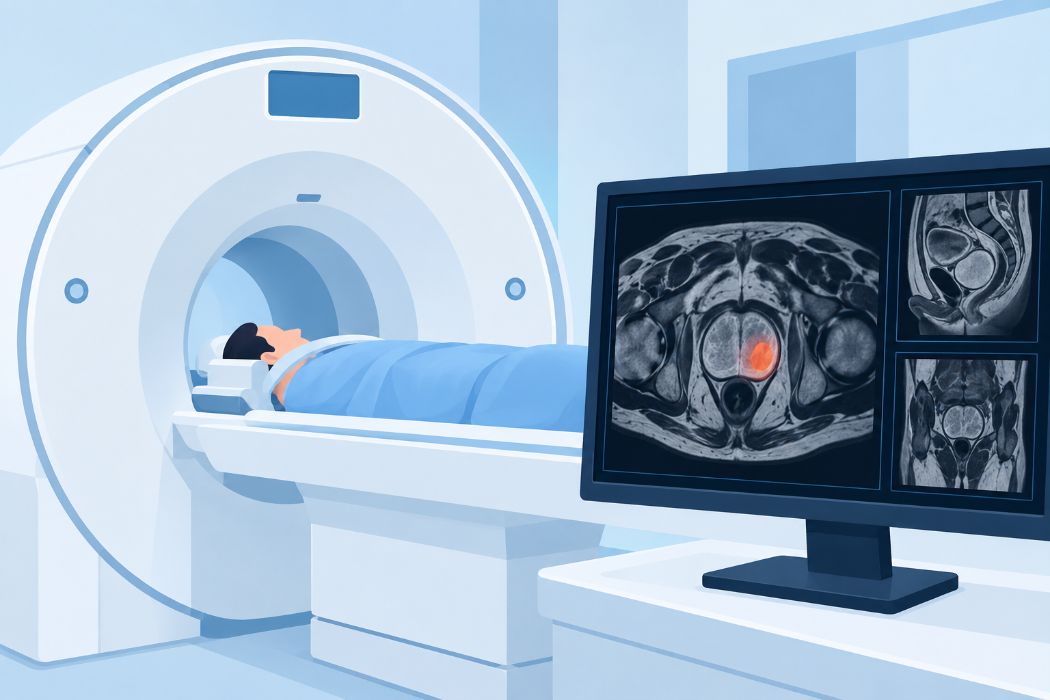
Mr Babu has a special interest in prostate MRI and prostate biopsy, following a modern, imaging-led pathway that improves diagnostic accuracy while sparing many men an unnecessary biopsy.
PSA testing & assessment
A PSA blood test and clinical examination help assess risk and decide whether further imaging is warranted.
Multiparametric MRI
A detailed prostate MRI identifies areas of concern and guides whether, and precisely where, a biopsy is needed.
Transperineal prostate biopsy
Targeted transperineal biopsy samples the suspicious areas accurately, with a very low risk of infection compared with older approaches.
Kidney cancer
Kidney cancer diagnostics
Many kidney masses cause no symptoms at all. They are often found by chance on an ultrasound or CT scan arranged for another reason, or during the investigation of blood in the urine.
Finding a mass on a scan can be worrying, but not every kidney mass is cancer - some are simple cysts or benign growths. Careful assessment is what tells them apart, and Mr Babu will explain what your scans show and what each next step means for you.
This page covers diagnosis only. Read about kidney cancer treatment options, including keyhole and robotic surgery.
How a kidney mass is assessed
- Review of your scans - the images that first showed the mass, alongside your symptoms and medical history.
- Dedicated imaging - usually a contrast CT or MRI scan to characterise the mass and, if needed, check whether it has spread.
- Blood tests to check your kidney function and general health.
- Consultation with Mr Babu to talk through the results and agree a clear plan, whether that is monitoring, further tests or treatment.
Testicular cancer
Testicular cancer diagnostics
A new lump, swelling or change in the feel of a testicle should be checked by a specialist. Most lumps turn out to be benign, such as a cyst or a collection of fluid, but a straightforward assessment gives you a clear answer.
Examination
Mr Babu discusses your symptoms and gently examines the scrotum to assess the lump and the surrounding structures.
Scrotal ultrasound
A painless ultrasound scan shows whether the lump lies within the testicle itself and helps distinguish benign conditions from a possible tumour.
Blood tests
Blood tests for tumour markers (AFP, hCG and LDH) add to the picture and, where cancer is suspected, help guide the next steps.
Why prompt assessment matters
Testicular cancer is most common in younger men and is one of the most treatable cancers, particularly when it is found early. Being seen promptly means a benign lump can be confirmed quickly, and if cancer is found, treatment can be planned without delay.
This page covers diagnosis only. Read about testicular cancer treatment options, including orchidectomy.
Patient information leaflets
The British Association of Urological Surgeons (BAUS) publishes independent, regularly reviewed leaflets explaining urological procedures, including flexible cystoscopy, investigation of blood in the urine and transperineal prostate biopsy. Mr Babu may recommend reading the relevant leaflet before your test or procedure.
Browse BAUS patient leaflets (opens in a new tab)Leaflets are general guidance; Mr Babu will discuss what applies to you at your consultation.
Your consultant
Mr Asrit Babu, Consultant Urologist
Mr Babu has a special interest in urological cancer diagnostics, with particular expertise in prostate MRI and transperineal prostate biopsy, alongside the prompt investigation of haematuria.
Read Mr Babu's full profileBook a consultation with Mr Babu
Appointments take place at Nuffield Health York Hospital. Book online through Nuffield Health, or call or email the practice if you would like to ask a question first.